

✎ New Chat
⌖ Search Chat
ℹ︎ PATA Report
✦ Online Course
Notebooks
—————————————
Disclaimer
The content on this page are 100% from our experts and their great minds.
Consume with reassurance that these information are accurate and fact-checked.
Where do we begin?
“Digital Agenda and Artificial Intelligence to Redesign Tourism“
Welcome! This page gathers expert perspectives from across the travel sector to answer our biggest questions about AI in this people-centric industry. Explore our topics below to build your own verdict on AI.
This page discusses 5 key topics:
AI & Consumer Travel Planning Behaviour: How is consumer using AI to plan their trips? How should businesses & destinations adapt?
AI & DMO: What changes should destination management organisations make to catch up with AI era?
AI & Sustainability: Can AI be used for good things that’s not just business optimisation?
AI & Tourism Workforce: Is AI really going to takeover this people-centric industry? How should the workforce prepare themselves?
Click on the topic above or the notebooks in the chat panel to invite the experts to the chat. ➡️













✎ New Chat
⌖ Search Chat
ℹ︎ PATA Report
✦ Online Course
Notebooks
Recents
—————————————
Disclaimer
The content on this page are 100% from our experts and their great minds.
Consume with reassurance that these information are accurate and fact-checked.
Starting a conversation on AI & DMOs…
While enterprise-level tech companies report scaling AI rapidly, adoption within the fragmented tourism sector tells a different story. Small and medium enterprises (SMEs) severely lag, with official adoption rates hovering between 4% and 20% globally (Source).
Between 90% and 99% of businesses report limited confidence in their ability to effectively implement and use AI technologies. This stems from a lack of technical skills and heavy "AI-Induced Resistance to Change" (AIRC). (Source)

Matt Gibson, UpThink
Research from Mindtrip, Sabre, Sojern and MMGY found 54% of travelers have used AI to plan a trip and 40% have discovered a destination through one, while only 22% of DMOs offer AI planning on their own site and only 26% have a documented AI strategy. Half of destination organizations say they're worried about AI-driven search disruption, but under a third expect their own website to be the source of truth for AI answers, and seven in ten report falling organic search traffic.

C.A. Clark , Miles Partnership
The biggest change that needs to happen is actually making sure the machines get to hear what the destinations are saying about themselves. We’re still designing websites for humans, but non-human traffic already exceeds human traffic. For years, there were two kinds of bots: Google and everything else, and most organisations sensibly blocked all but a few of the bots. But now those bots are critically important to influencing AI responses.
Before you change the way you position your destination, you need to ask the unglamorous question: whether you’re letting the bots in and whether or not they’re successfully reading what you already have. Too many organisations are using outdated bot-blocking rules that are handicapping their content by preventing the very visits that would help their AI visibility.
Matt Gibson, UpThink
Build AI personas of your target visitors and use them to conceptualize new products and messaging strategies. (Proof on its accuracy). On-demand synthetic feedback is a game-changer for the early stages of testing new concepts. Give them your ideas and then test the survivors on real humans, because synthetic audiences are good for a first pass but poor at emotional truth.
Build Generative Engine Optimization. Chatbots are already describing your destination; the question is whether they're describing it correctly. The fix is technical but effective. Add an llms.txt file to your website and use software to convert the pages into AI-agent-ready markdown (.md) files. Publish structured, machine-readable destination data, and content with specific facts and named sources. As with SEO, doing these simple things will give you a leg up on the competition.

Florian Blois, Dida
This new AI trip-planning behaviour is helping more niche, experience-led travel and smaller destinations that rarely surfaced in traditional search rankings.
Visibility for destinations now depends on whether an AI model can find, understand and trust your information. Tourism boards and hotels are rewriting content in clear, structured Chinese, keeping prices and availability current, and working with the platforms these assistants draw on. Striking imagery still matters on social media, but accurate, machine-readable detail is what gets a destination recommended.

World-First NTO Integration: Tourism Fiji is the first national tourism organisation to fully integrate AI across both trip inspiration and booking for the Chinese market.
Conversational Discovery (TikTok AI Travel Planner): Users could instantly generate customised, visual day-by-day itineraries using natural language conversations, enriched by real influencer content.
Conversational Booking (Qwen + Fliggy Integration): Utilising Alibaba's Qwen LLM on Fliggy, the AI preserved travel context, checked real-time pricing and inventory, auto-applied deal discounts, and finalized bookings through natural agent-like dialogue.
Democratising Personalisation: The system provided 24/7 bespoke travel planning at scale, delivering hyper-personalized itineraries for honeymooners, families, and luxury travellers.
By bridging content discovery with transaction ease, Tourism Fiji achieved a 15% planning-to-booking conversion rate (vs. the 2–3% industry average), a 45% increase in Chinese visitor arrivals, and over 500 million TikTok impressions.


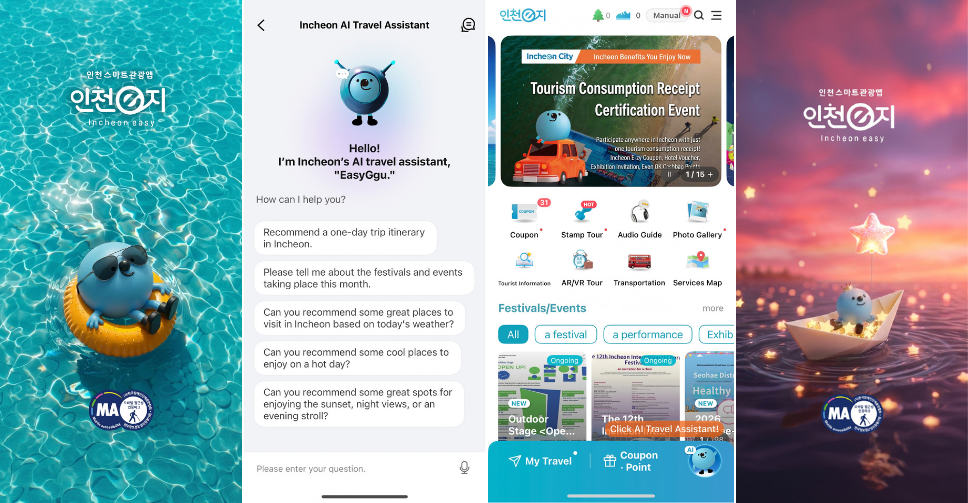
By integrating Gemini LLM and Retrieval-Augmented Generation (RAG) technology, the app’s AI Travel Assistant, "Easy-Ggu," provides travellers with real-time, hyper-personalised itinerary curation. Rather than functioning solely as an informational tool, INCHEON EASY directly drives destination management and local business revitalisation.
Through gamified smart stamp tours, location-based discount coupons, and multi-lingual digital support, the platform has connected over 330,000 users directly to more than 460 local merchants, traditional markets, and night market venues.
This seamless digital linkage generated over 10.6 billion KRW in estimated local consumption, proving that smart tourism technology can effectively increase visitor stay times and distribute economic benefits directly into local communities.
Vincent Zheng, Tourism Fiji
For Tourism Fiji, this travellers adopting AI for travel planning means translating individual interests into bookable journeys. In China, our AI ecosystem collaborating with TikTok and Fliggy, guides travellers from discovery through tailored itineraries to real-time booking. The pivotal shift from telling travellers what Fiji offers to helping them comprehend how Fiji meets their unique aspirations makes our marketing more responsive and measurable.
AI enables us to move beyond a one-size-fits-all image. We can now respond with greater precision, helping travellers discover the islands, cultures, and hidden corners of Fiji that resonate most personally with them.

Mikyung Je, Incheon Tourism Organization
We treat Incheon Easy as a real-time signal based on actual search keyword data. This lets us identify which attractions, routes, and seasons are underused by specific visitor groups, and run customised campaigns accordingly, rather than promoting the same popular sites to everyone. As a result, we can pursue more balanced destination management — for example, steering interest toward less crowded sites during peak periods.
Previously, visitor communication was largely one-way — we published information and measured interest through participation, redemptions, or view counts. With AI, communication has become genuinely interactive: visitors now describe, in their own words, exactly what they are looking for, letting us monitor actual search keywords and query content rather than counts alone.
C.A. Clark, Miles Partnership
The biggest opportunity was never the public-facing tools; it’s bringing AI inside the organisation and using it effectively to create new value. Orgs put too much focus on task replacement when the real gold is in understanding deeply what your stakeholders value from you, then delivering it in ways you could not before.
Example:
A destination I work with promotes film across many separate jurisdictions, each issuing permits locally. Because each area measured impact individually, nobody could ever see the full economic picture brought by these films. Using AI, they pulled the data together and built an interactive dashboard with heat-mapping and visualisation, finally showing what film permits returned to each community. Millions of dollars of positive impact, made visible at last.
That dashboard would have been practically impossible for that team, who were never going to spend tens of thousands proving a point. A month-long process is now an afternoon conversation with the right AI tooling and support inside the organisation.

Sarah Mathews, E-Tourism Frontiers
Authenticity has become a fashionable word, but travellers have always wanted authentic experiences, just as experiential travel was never new. It comes down to storytelling, managing expectations and being honest about what you are. Honesty is exactly what AI-generated imagery takes away.
The difficulty sits with the long tail of creators, and DMOs have real leverage there. A DMO can say plainly that it will not pay for AI-generated visuals, will not repost or allow tagging on synthetic imagery of the destination, and will ask for it to be removed. Where a creator's genuine work is beautiful, approve it, license it and pay them for access.

Mochamad Nalendra, Wise Steps Consulting
For community-based tourism, AI could help transform local knowledge into tourism experiences, stories and promotional content, while enabling communities to reach wider markets. However, communities should remain the owners and custodians of their cultural knowledge. AI should support their creativity and capabilities, rather than replace local voices, authenticity or human interaction.

Jessie McComb, ADB
Given the intensification of AI in everyday life, tourists are now desperately seeking authentic experiences; this puts additional pressure on destination branding to deliver on its promises. Protecting the human elements of your marketing, branding, experiences, and service provision will be what sets destinations apart in the future.
Vincent Zheng, Tourism Fiji
Preparing for AI is not about adopting new tools, but strengthening three pillars: data, people, and partnerships. Destinations must invest in accurate, well-structured data, as AI-driven recommendations depend on information quality. Organisations need to build AI literacy across teams, understanding how AI reshapes consumer behaviour and the travel journey. Strategic partnerships are equally vital.
Tourism Fiji's collaborations with TikTok and Fliggy show that combining destination expertise with technology delivers the best outcomes.
Above all, AI should enhance, not replace, human judgement and storytelling. Organisations that thrive will adopt AI purposefully, responsibly, and always with the traveller at the centre.
Jessie McComb, ADB
The most important thing that tourism organizations can do to prepare for AI is to accept that it’s here—your employees, businesses, and tourists are already using it. Creating policies that guide effective and well-managed use of AI will help employees and stakeholders understand both the benefits and the risks and will provide them an above-the-board way to use it. This will allow leadership to manage and oversee its use and mitigate its impacts.
From a destination leadership perspective, DMOs should support their stakeholders to understand its benefits and risks and guide them on what tools are useful and reliable. However, tourism organization also need to understand where AI’s limitations outweigh its benefits.